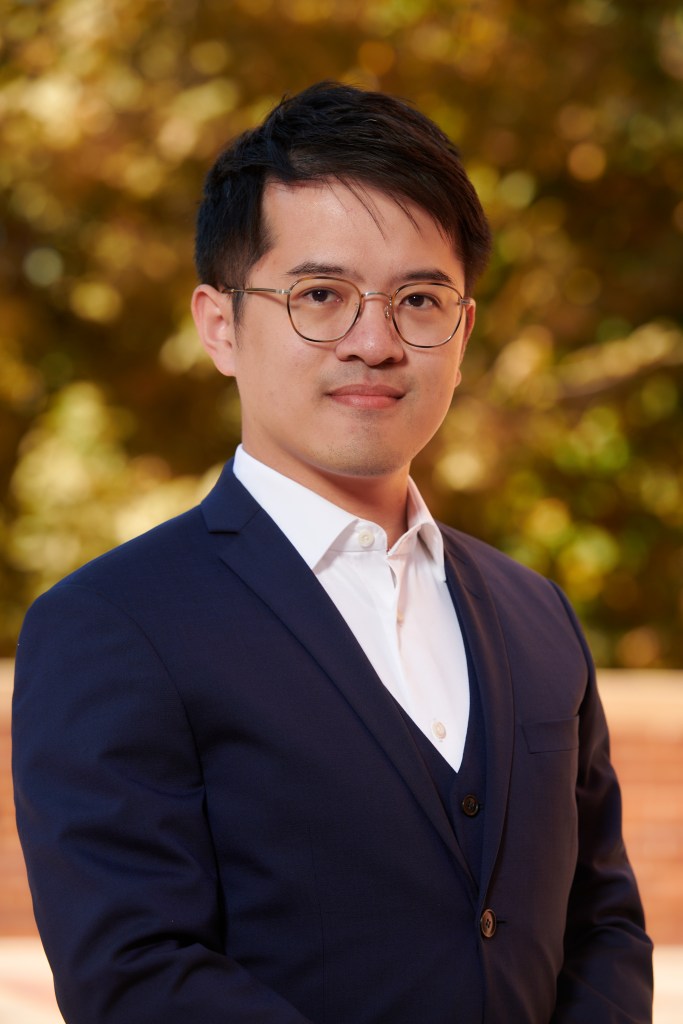
Kai Chiu Yang
Ph.D. Candidate, Accounting
UCLA Anderson School of Management
110 Westwood Plaza
Los Angeles, CA 90095
Welcome!
I am Kai, a Ph.D. Candidate in Accounting at Anderson School of Management, University of California – Los Angeles (UCLA). I expect to graduate in 2027 and will be on the 2026-2027 academic job market.
My research studies how information, incentives, and institutions shape firms’ decisions and real outcomes, with current projects on credit rating, goodwill accounting, voluntary compliance, and operating capacity management.
Before my Ph.D., I earned an M.A. in Economics from the University of Zurich and a B.B.A. in Accounting from Guanghua School of Management at Peking University. I am also an active CPA candidate (all exam passed) with experience in finance and strategy roles in the technology and consumer electronics industries.
Outside of academics, I enjoy hiking, photography, and spending time with my dog.
Feel free to reach out at kaichiuyang@g.ucla.edu!
Research
[1] Credit Ratings and Intermediary Scrutiny
Solo Authored
Abstract
This paper studies how firms communicate information to investors through rating agencies that map a firm’s disclosures into finite rating categories (e.g., letter grades). I show that this discrete structure can improve informativeness by disciplining strategic misreporting. However, a fundamental tension arises: while a finer rating scale enhances precision, it exacerbates rating inflation. When intermediaries provide sufficient scrutiny and employ an appropriate number of ratings, intermediation improves informational efficiency and reduces aggregate signaling costs, driving voluntary adoption. Furthermore, optimally designed rating standards generate rating distributions that are typically less skewed than the underlying fundamentals, unless the rating system is quantile-based.
- Committee: Beatrice Michaeli (Chair), Judson Caskey, Henry Friedman, Alexander Bloedel
- Presented at: UCLA, 2026 Western Region Doctoral Student/Faculty Interchange
[2] Dynamic Capacity Management: Implications for Operating, Investing, and Financing Activities
with Felix Zhiyu Feng, Henry Friedman, and Beatrice Michaeli
Abstract
Firms adjust operating capacity via substantial acquisitions, expansions, divestitures, and spin-offs, and exert significant search effort identifying opportunities to do so cost effectively. We embed capacity adjustment and search in a dynamic model to understand how they interact with the firm’s operating decisions (risk-management), financing decisions (distributions and capital raises), and liquidity (cash position). We find that capacity-related search efforts are U-shaped in firm liquidity: highest when firms have either small or large cash positions. The firm’s costly efforts to mitigate operational risk move with capacityrelated search (acting as strategic complements) when liquidity is low and diverge (acting as substitutes) when liquidity is high. We provide testable predictions related to the frequency of major capacity adjustments, net capacity growth, payout timing, cash-flow volatility, and capital raises. We also relate our predictions to firm life cycle classifications based on firms’ cash flows.
- Presented at: Bocconi University, 2025 AES Annual Conference, 14th Zurich Accounting Research Workshop, Accounting Summer Camp 2025 – VIII Edition (Naples), 2025 HKU Accounting Theory Conference
with Judson Caskey
Abstract
We develop a model where firms choose whether to comply with an accounting rule that places an upper bound, such as historical cost, on the report and mandates recognition of bad news. Firms may also make unregulated assertions that their value exceeds the upper bound permitted by the accounting rule. In this context, improved enforcement of accounting rules enhances the credibility of firms’ unregulated claims. Firms’ willingness to recognize large impairments depends mostly on misreporting costs, while their willingness to recognize small impairments depends mostly on investors’ prior beliefs and whether a small impairment would be interpreted favorably. Consistent with our model, we find preliminary empirical evidence that investors respond favorably to small impairments by firms with low market values relative to book value.
- Presented at: UCLA, Purdue University, 2025 AES Winter Retreat
[4] Investment Intermediaries, Preferences, Returns, and Risk
with Henry Friedman and Mirko Heinle
[5] The Value Relevance of Goodwill and Subsequent Impairments
Solo Authored
Teaching
Teaching Assistant, UCLA
- Financial Accounting (MBA, EMBA), Prof. Henry Friedman, 2025
- Financial Accounting (MBA, EMBA), Prof. Terrence Shi , 2025
- Financial Accounting (UCLA-NUS EMBA), Prof. Carla Hayn, 2025
- Corporate Governance (EMBA, UCLA-NUS EMBA), Prof. Carla Hayn, 2025-2026
- Mathematical Economics (Undergraduate), Prof. Daniel Clark 2024-2025
- Introduction to Financial Accounting (Master of Applied Economics), Prof. Brett Trueman, 2023,2025
Experience
Conference Participation
- 2026 Columbia Accounting Theory Conference
- 2026 Western Region Doctoral Student/Faculty Interchange (DSFI)
- 2025 Journal of Accounting & Economics Conference
- 2025 Journal of Accounting & Economics Doctoral Consortium
- 2025 Accounting and Economics Society (AES) Conference
- 14th Zurich Accounting Research Workshop
- 2025 Columbia Accounting Theory Conference
Academic Service
- Conference Reviewer, AAA Annual Meeting, 2026
Honors & Awards
- UCLA Graduate Fellowship, UCLA, 2022-2027
- First-Class Annual Scholarship, Peking University, 2014
- Social Service Award, Peking University, 2014
Education & Professional Qualification
- Ph.D. in Accounting, UCLA, 2027 (expected)
- M.A. in Economics, University of Zurich, 2022
- B.B.A. in Accounting, Peking University, 2016
- CPA candidate – all exams passed
Industry Experience
- OPPO Mobile (Shenzhen, China) – Financial Supervisor, Senior Budgeting Manager (2019-2020)
- Victor Hasselblad AB (Gothenburg, Sweden) – Post-Investment Manager (2017-2019)
- DJI Technology (Shenzhen, China) – Senior Financial Analyst (2017-2019)
- Huawei Technologies (Abidjan, Cote d’Ivoire) – Financial Analyst (2016-2017)
 Kai Chiu Yang